Insights Perspective
AI is no longer a tool. It's becoming a thinking partner.
People now use AI to think and decide, not just to write. What that means for business.
Artificial Intelligence has evolved far beyond its original promise of helping people write faster, automate repetitive work, or answer questions.
Today, AI is becoming something much bigger.
People are using it to make decisions, learn new skills, solve complex problems, plan their lives, improve their work, and increasingly, help them think.
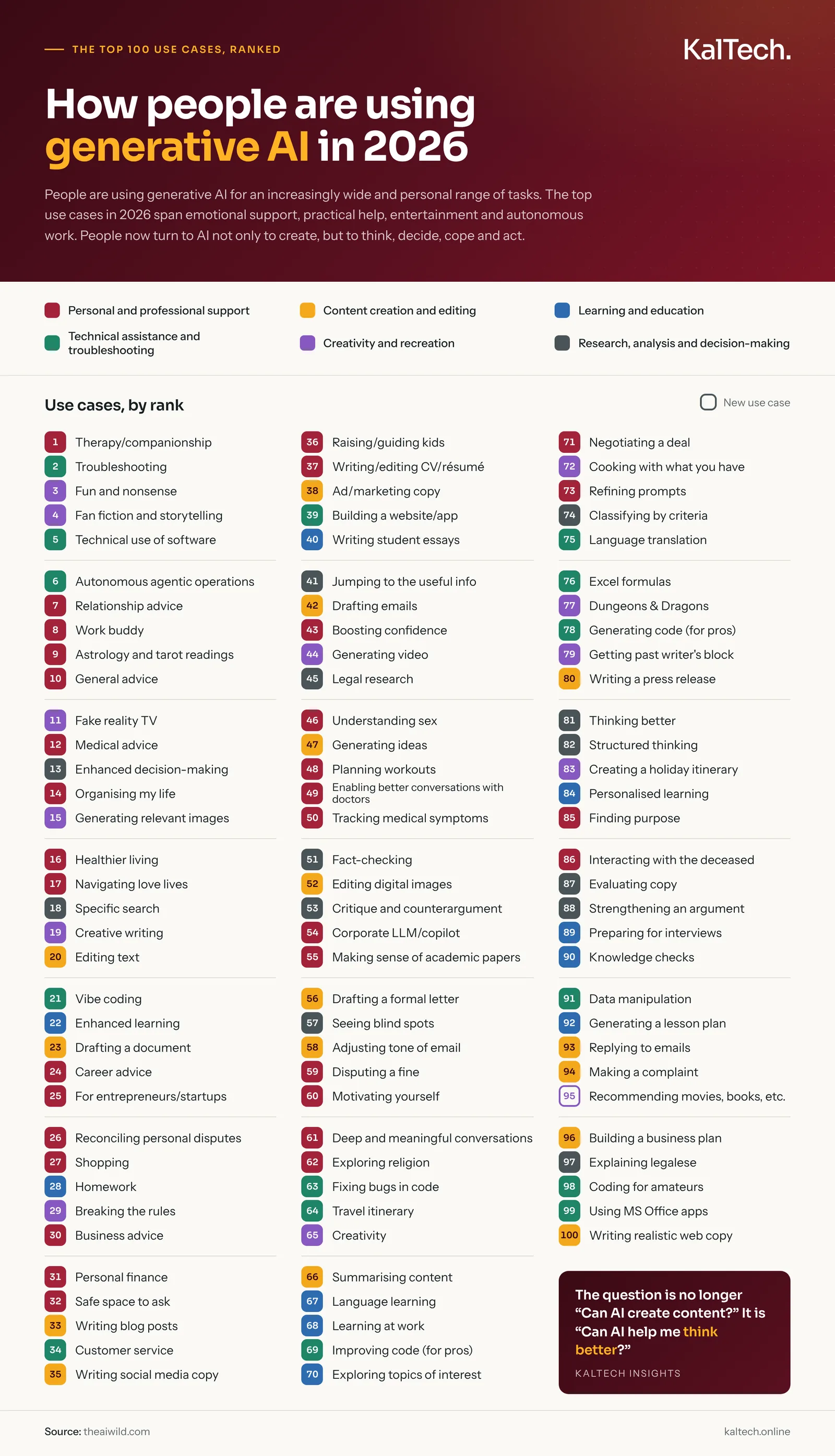
Looking at the data, one thing becomes immediately clear:
AI is no longer being used primarily as a content-generation tool.
It is becoming a decision-making, problem-solving, and productivity partner.
The use cases span six major categories:
- Personal and professional support
- Content creation and editing
- Learning and education
- Technical assistance and troubleshooting
- Creativity and recreation
- Research, analysis and decision-making
What’s even more interesting is that many of the fastest-growing use cases aren’t focused on content creation at all.
They are focused on helping people think.
The shift from content creation to cognitive assistance
A few years ago, most AI conversations revolved around writing blog posts, generating images, creating social media content, or drafting emails.
Those use cases still exist.
But the data suggests something bigger is happening.
People are increasingly using AI for:
- Enhanced decision-making
- Structured thinking
- Identifying blind spots
- Business planning
- Problem solving
- Learning new skills
- Career guidance
- Research and analysis
This represents a fundamental shift.
The question is no longer:
“Can AI create content?”
The question is:
“Can AI help me think better?”
For professionals, entrepreneurs, and business leaders, this may be the most important development in AI adoption so far.
The risk: outsourcing thinking
While AI can dramatically improve productivity, there is an emerging challenge that organizations need to recognize.
Many people are beginning their thinking process with AI rather than using AI to improve already-developed thinking.
Instead of clarifying an idea first, they ask AI what they should think.
Instead of defining a strategy, they ask AI to generate one.
Instead of developing a position, they ask AI to write one.
The result is often faster output but weaker original thinking.
AI can accelerate intelligence. It cannot replace judgment.
The most successful professionals will not be those who depend entirely on AI.
They will be those who combine human expertise with AI capabilities.
What businesses are getting right
At KalTech, we work with organizations implementing AI across operations, customer service, sales, recruitment, healthcare, and enterprise workflows.
The most successful implementations rarely start with technology.
They start with a business problem.
The companies generating the highest returns from AI typically focus on three areas:
1. Efficiency
Reducing repetitive work.
Examples include:
- AI-powered customer support
- Automated documentation
- Smart reporting
- Process automation
2. Growth
Enabling teams to do more without proportionally increasing costs.
Examples include:
- AI outbound sales agents
- Lead qualification systems
- Recruitment automation
- Customer engagement platforms
3. Transformation
Completely redesigning workflows around AI capabilities.
This is where the biggest opportunities exist.
Instead of asking:
“How can AI improve this process?”
Leading organizations are asking:
“If we rebuilt this process from scratch today, what would it look like with AI at the center?”
The answers are often dramatically different.
The rise of AI-native organizations
The next generation of successful businesses will not simply use more AI tools.
They will operate differently.
Their workflows will be designed around intelligent automation.
Their teams will spend less time on repetitive tasks and more time on strategy, creativity, and decision-making.
Their systems will learn, adapt, and improve continuously.
In many ways, we are witnessing the beginning of AI-native organizations.
Organizations where AI isn’t an add-on.
It’s part of the operating model.
What we're seeing at KalTech
At KalTech, we’ve worked on AI projects across healthcare, fintech, e-commerce, customer service, recruitment, and enterprise automation.
One thing has become very clear:
The companies getting the most value from AI aren’t necessarily the ones using the most AI tools.
They’re the ones asking better questions.
Instead of treating AI as a shortcut, they use it as a strategic advantage.
Instead of automating a single task, they redesign entire workflows.
Instead of replacing people, they empower teams to focus on higher-value work.
Whether it’s an AI recruitment engine that reduces hiring time, an outbound sales agent that scales customer engagement, or intelligent healthcare systems that improve operational visibility, the biggest wins happen when AI is aligned with a real business objective.
Technology alone doesn’t create transformation. The right strategy does.
Final thoughts
The most important takeaway from this research isn’t that AI can generate content faster.
It’s that people are increasingly turning to AI to help them think, learn, decide, and act.
That shift changes everything.
The future of AI isn’t about replacing humans.
It’s about augmenting human capability.
At KalTech, we believe the next generation of industry leaders will be organizations that combine human expertise with intelligent systems, using AI not just to do things faster, but to operate smarter.
Because the real competitive advantage won’t come from having access to AI.
It will come from knowing how to apply it to solve real business problems, unlock new opportunities, and build organizations that are ready for what’s next.
If you’re exploring how AI can drive efficiency, growth, or transformation in your business, we’d love to start that conversation.
More from Insights