Work BECS
BECS
A blood bank asked us to digitise its forms. We encoded the compliance sequence instead.
- Sector
- Hospital blood bank operations
- Scale
- Multi-branch network
- Engagement
- Diagnostic, then platform build
- Constraint found
- Process
- Systems
- Donor lifecycle, screening workflow, component inventory, issuance and audit
The situation
Blood bank operations ran on paper forms and spreadsheets. Donor records, screening results, component inventory and issuance were each recorded, but in separate places and mostly after the event.
The brief asked for digitisation. Take what is on paper and put it on a screen.
The constraint we found
Process
The binding constraint
Compliance checkpoints were being recorded after the fact rather than enforced during the work. A screening result written up at the end of a shift documents that a check happened. It does not prevent a unit advancing before the check is complete.
Digitising that faithfully produces a faster version of the same exposure. The question was not how to record the work. It was whether the work could be specified tightly enough that the system could refuse to let it happen out of order.
What we considered and set aside
Digitise the forms
What was briefed. Delivers a searchable archive and changes nothing about the risk.
Buy an off-the-shelf blood bank system
Viable in principle. The available options assumed single-site operation and would not hold a multi-branch network under one inventory view.
Encode the compliance sequence
The path taken. Build the workflow so that ISBT 128 requirements are gates in the process rather than fields on a record.
What was built
-
01
Donor lifecycle management
Registration, history, eligibility and deferral tracking held as one record across branches, so a donor deferred at one site is deferred at all of them.
-
02
Automated screening workflow
Screening as an enforced sequence. A unit cannot progress to component processing until the required results exist and pass.
-
03
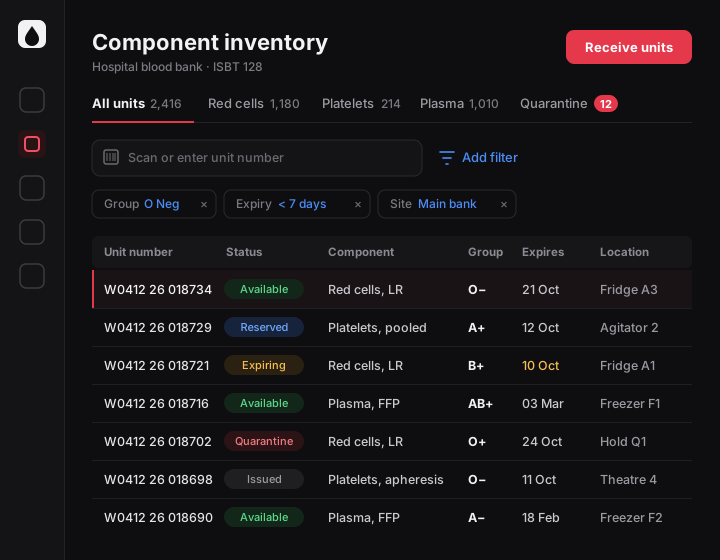
Component inventory, live
Stock by component type, group and expiry across the branch network, visible in one place.
-
04
Issuance and audit tracking
Every unit traceable from donor to recipient, with the audit trail generated by the work rather than assembled for an inspection.
-
05
Multi-branch control
One operating picture across sites, with branch-level permissions and a single inventory view above them.
What made the difference
Treating compliance as a property of the workflow rather than a report produced from it. That distinction is the difference between a system that documents what happened and one that constrains what can happen. In regulated operations it is the only version worth building.
Outcome
What moved.
100%
Unit traceability, donor to patient
40%
Admin cost reduction
ISBT 128
Compliant
Validation
Decided by the code, not the operator
Figures drawn from client-side reporting.
Start Here
Start with the question, not the brief.
For companies operating above $1M in revenue with a specific commercial problem.
A 30-minute call. You describe what you are considering building. We tell you which of the three lenses we would run it through first, and whether we are the right firm for it. No fee, no deck, no follow-up sequence.
- 0130 Minutes
- 02No Fee
- 03No Deck