Work KalPay
KalPay
A lending platform built for an operation writing loans faster than it could process them.
- Sector
- Regulated consumer lending
- Scale
- 10,000+ applications per day at peak
- Engagement
- Diagnostic, platform build, then ongoing delivery
- Constraint found
- Process
- Systems
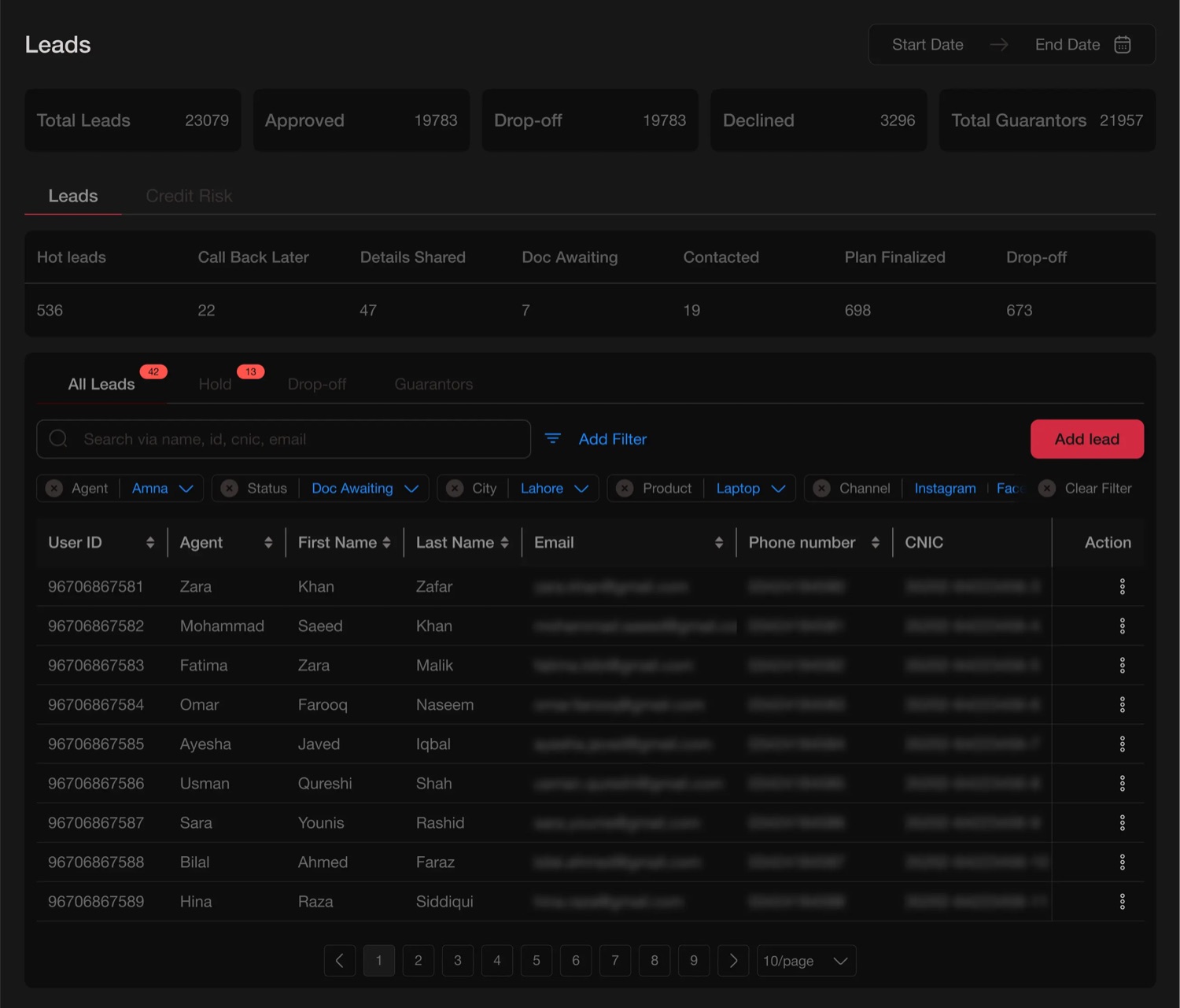
- Borrower portal, agent console, risk tooling, analytics
The situation
KalPay runs BNPL and device financing under regulatory supervision. Every approval passed through a manual queue, whatever the risk of the application, so throughput was capped by the number of reviewers.
The review criteria existed, but they lived in the reviewers rather than in a written policy. Nothing could be automated, audited or scaled until they were written down.
The constraint we found
Process
The binding constraint
The question was whether the reviewers applied their criteria consistently enough to write down. The diagnostic established that they did. The work was specified tightly enough to encode, and the queue was holding back decisions that did not need a person.
Had the criteria varied from reviewer to reviewer, automating them would have scaled the inconsistency. Because they held, the build could start from a policy rather than from a guess.
What we considered and set aside
Hire more reviewers
Throughput rises with headcount, and so does cost, while the criteria stay unwritten.
Approve automatically above a credit score
Quick to ship. It replaces the reviewers' judgment with a single threshold that nobody had tested against their decisions.
Encode the reviewers' criteria
The path taken. Write the referral criteria down, apply them in a lending console, and keep manual review for the cases the policy says need it.
What was built
-
01
Lending console
Returns most decisions without a person in the queue.
-
02
Written referral criteria
The reviewers' judgment recorded as policy and applied the same way every time.
-
03
Manual review by exception
A reviewer sees only the cases the policy refers to them.
-
04
Document verification in the flow
Verification positioned as a gate rather than a step an agent could reorder, so an application cannot advance in an ambiguous state.
-
05
Admin and risk tooling
Configuration, thresholds and audit trail in one place, so a policy change is a setting rather than a retraining exercise.
What made the difference
Testing the criteria before automating them. Encoding a consistent policy lifted the limit that headcount had placed on throughput. Encoding an inconsistent one would only have automated the inconsistency.
Outcome
What moved.
60%
Decisions returned without manual review
92%
Reduction in non-performing loans
30%
Increase in customer conversion
$1.8M
P&L impact
Figures drawn from client-side reporting.
Start Here
Start with the question, not the brief.
For companies operating above $1M in revenue with a specific commercial problem.
A 30-minute call. You describe what you are considering building. We tell you which of the three lenses we would run it through first, and whether we are the right firm for it. No fee, no deck, no follow-up sequence.
- 0130 Minutes
- 02No Fee
- 03No Deck