Insights Perspective
AI did not kill software. It killed the excuse.
AI made software easy to copy. That puts every SaaS renewal up for review.
For decades, software was protected by one simple thing: it was hard to copy. That protection is gone.
In October, Kotaku reported that hundreds of classic games and emulators had been rebuilt with AI in a couple of weeks, some running in a web browser and described as “borderline flawless”. If a twenty-year-old game can be reverse-engineered in weeks, so can a project management tool.
Investors saw it coming. In early February, after Anthropic launched AI tools that could take on work people once paid subscriptions for, software stocks lost roughly $285 billion in value in a single day. A Jefferies trader gave it a name: the “SaaSpocalypse”.
The worry was simple. If one AI agent can do the work of five people, a company may need one software seat instead of five.
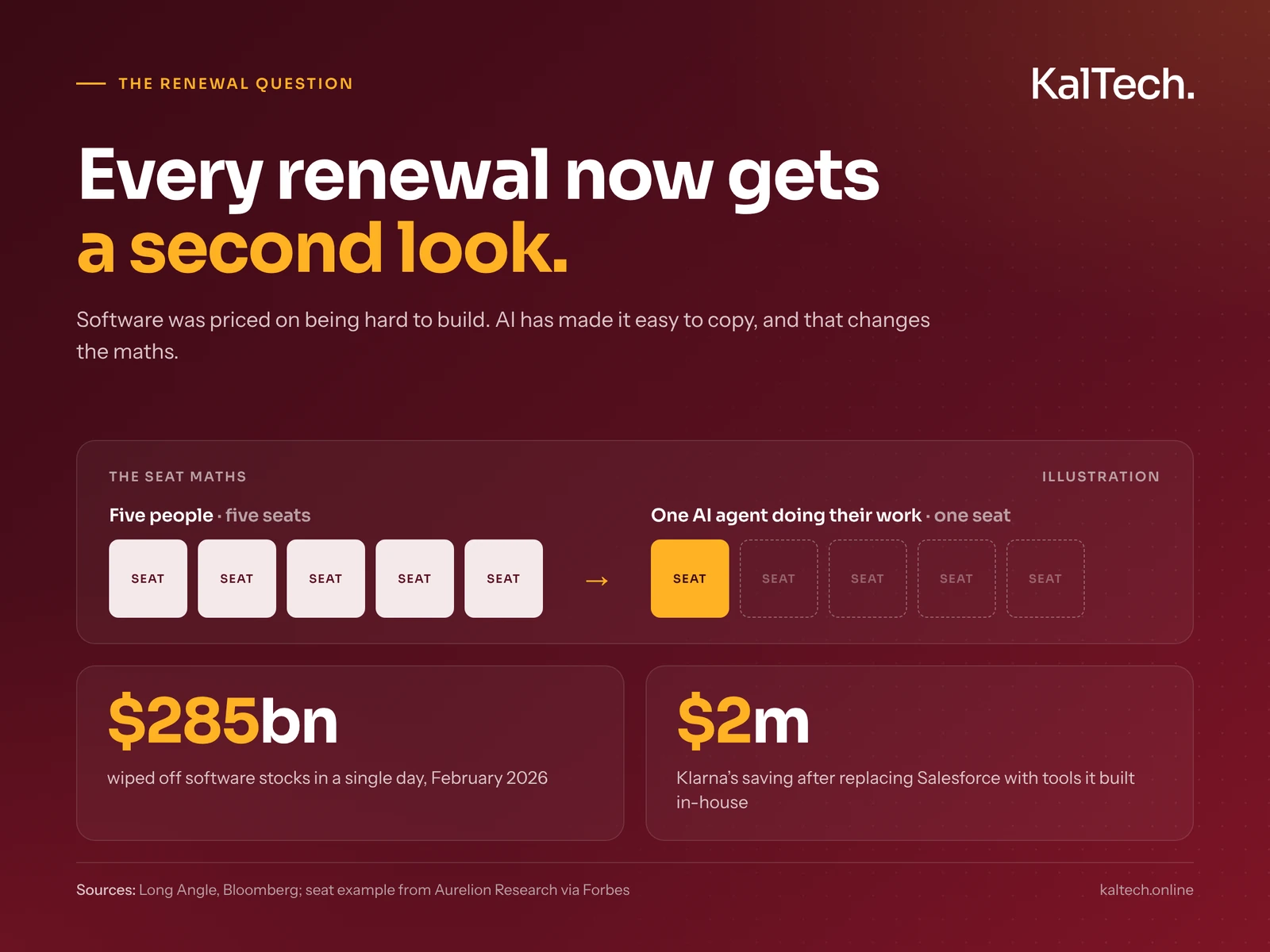
Now companies are doing the maths themselves. Klarna dropped Salesforce for data tools it built in-house with AI, and its chief executive later said the switch saved about $2 million.
The same thinking is now reaching everyday tools. A senior figure at a large PR firm told KalTech the firm had replaced Monday.com with its own AI-built version, saving around $4,000 a month.
That is the real threat to SaaS. Not that every tool gets replaced, but that every renewal now gets a second look: keep paying, or build the parts the team actually uses.
But copying a tool is not the same as owning one. A subscription quietly covers things a homemade version has to handle alone: security updates, backups, bug fixes and someone to call when something breaks at midnight. A clone that saves $4,000 a month can cost far more the day it exposes client data.
There is also a line worth drawing. Rebuilding the features a team needs for internal use is one thing. Copying another company’s product, design or code and passing it off as original is another. AI makes both easy. Integrity decides which one a business does.
So SaaS is not dying. The lazy version of it is: tools priced per seat, packed with features nobody uses and protected only by being hard to build.
The software that survives will have to earn its fee every single month. And companies building tools in-house will need to treat that code with the same care as any product carrying the company’s name.
Copying has never been easier. Doing it responsibly still takes judgement.
Sources
- Kotaku: Vibe-coded browser ports of Halo, The Simpsons: Hit and Run and GTA: Vice City (9 October 2026) (opens in a new tab)
- Forbes: SaaSpocalypse now? AI is disrupting SaaS, but not all software is doomed (6 February 2026) (opens in a new tab)
- Long Angle: Software vs. AI Q1 2026, SaaSpocalypse examined (opens in a new tab)
- Forrester: SaaS as we know it is dead (11 February 2026) (opens in a new tab)
- Bloomberg: Klarna saved $2 million after cutting ties with Salesforce (June 2025) (opens in a new tab)
More from Insights